

















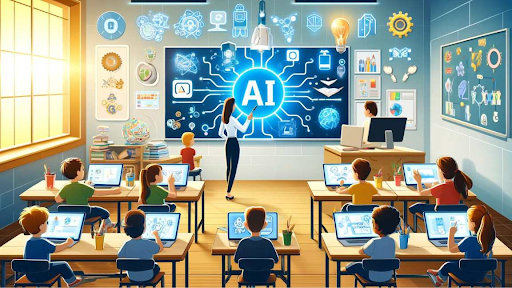


Artificial intelligence (AI) apps such as ChatGPT have over 1.7 billion downloads in 2025 alone. This overuse of AI is a significant hindrance both outside and inside the classroom. Instead of going through the decision-making process and utilizing their creativity, people have begun to rely on AI for nearly everything. According to Fortune, recent research from the College Board found that 84% of students use generative AI for school assignments.
Whether it is for solving simple math problems, writing lengthy essays, or cheating on an online test, students’ work is rarely 100 percent original.
Unfortunately, Bridgewater Raritan High School is no exception. Students argue that AI is an innovation that they are simply embracing—and Harvard seems to agree with them. A recent article even argues that educators should “engage with generative AI tools with…[their] students…when possible” (Embracing Artificial Intelligence in the Classroom).
However, when looking closer at Harvard’s 2023 article, “Embracing Artificial Intelligence in the Classroom” by Elizabeth M. Ross, its argument is not quite as in favor of AI as it seems to be. Ross writes, “One frequent concern about generative artificial intelligence is that students will use it to cheat and avoid the hard work of thinking for themselves, but… tools like ChatGPT should really challenge teachers and professors to reassess the assignments they give their students.” In other words, AI should be a tool, not an answer key; assignments should force students to elaborate in a way that AI is unable to.
Yet, despite the usefulness of AI, it comes with many dilemmas that can lead to overreliance rather than innovation. When used with limitations, it has great value—but students tend not to know when to stop. For example, the use of AI in Bridgewater Raritan High School breaks the school’s Academic Integrity Policy; students are expected to hand in original work that they completed on their own. Yet more and more students find themselves with zeros after being caught for using AI, often unable to define words they supposedly wrote themselves.
Such abuse of AI deprives students of the ability to complete assignments independently, which undermines the purpose of education, a fact supported by Princeton University. According to Princeton University’s Professor Noteman, “these ‘tools’ turn professors into cops and students into suspects by making it so easy… to cheat on assignments.” AI gives students the temptation to cheat rather than do the work themselves, simply because they know they have such an option.
Professor Robert Gehl from York University in Toronto strongly agrees with this, emphasizing that, “GenAI can simulate all of the steps: It can summarize readings, pull out key concepts, draft text, and even generate ideas for discussion. But that would be like going to the gym and asking a robot to lift weights for you.” School is designed to provide students with academic knowledge, helping them develop the skills and knowledge they need to succeed in the future. AI deprives students of the opportunity to acquire fundamental knowledge independently and grow as learners. An undeserved A grade today does not constitute success in a job tomorrow.
While AI has its advantages, it also has no place in a classroom designed for students to learn. AI prioritizes quick rewards over long-term knowledge and accomplishment, depriving students of their ability to think critically. Until a time comes when kids can differentiate between using AI as a tool and using it as a way to cheat, it’s safe to say that AI is over-relied on. At least for the time being, safeguards such as Bridgewater Raritan High School’s Academic Integrity Policy are the way to go.
While it is still not uncommon to see a student sneaking onto ChatGPT during class, hopefully, there will come a time when students realize AI isn’t helping them—it is the illusion helping you paint a beautiful portrait, until you realize you are no longer the artist.